


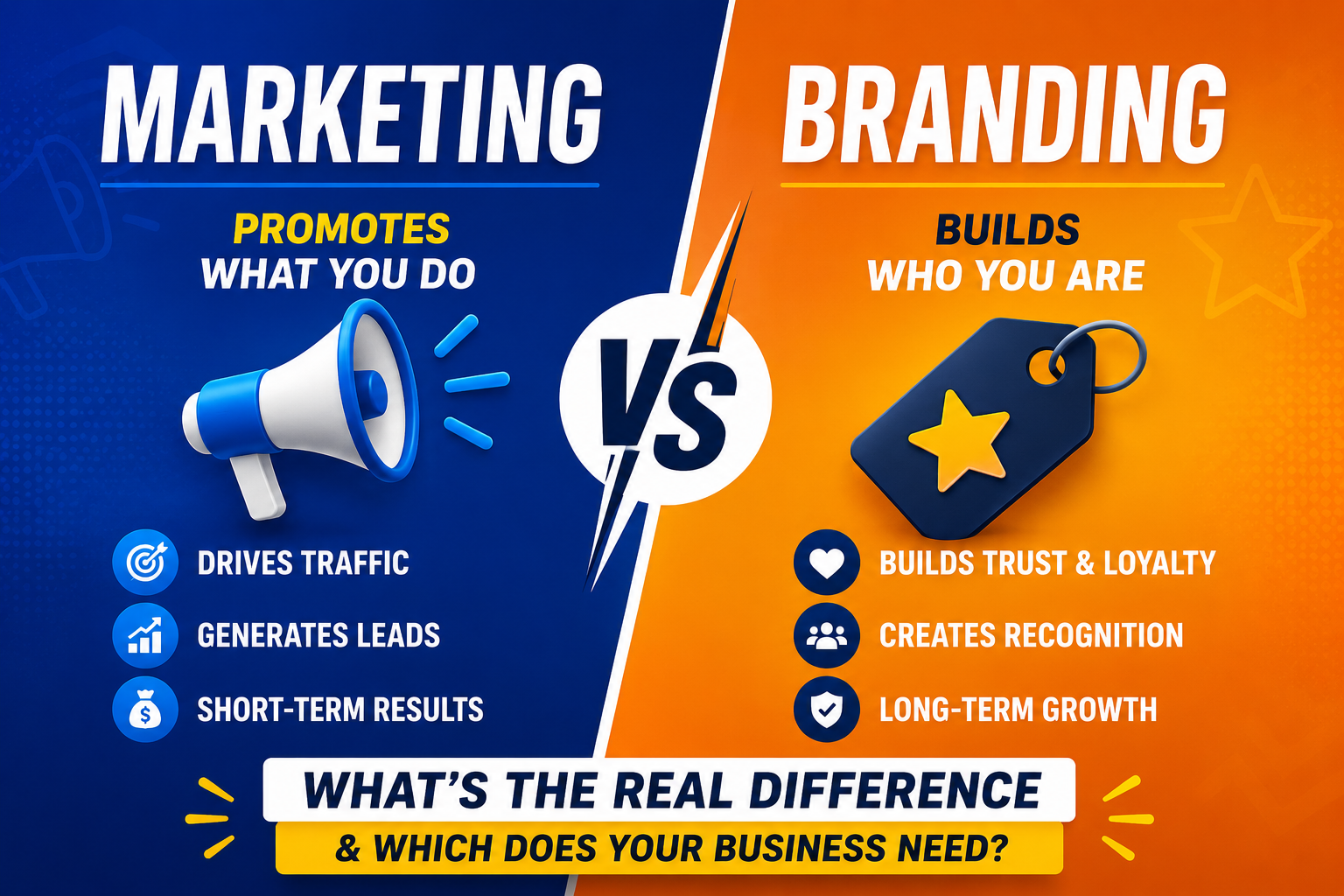
Marketing helps you attract customers, while branding gives customers a reason to trust, remember, and choose your business. Marketing focuses on generating leads and sales through strategies like SEO, Google Ads, social media marketing, and email campaigns. Branding creates your business identity through your logo, messaging, customer experience, and reputation. Businesses that combine both marketing and branding achieve stronger long-term growth, better customer loyalty, and higher returns on their marketing investment.
Introduction
If you ask ten business owners about the difference between marketing and branding, chances are you'll receive ten different answers. Some believe both terms mean the same thing, while others think branding is simply designing a logo. In reality, marketing and branding have different purposes, yet they work together to build successful businesses.
This misunderstanding often causes businesses to spend heavily on advertising without creating a memorable identity. As a result, they may attract customers once but struggle to earn repeat business or referrals.
At Systoo Technologies, we've worked with businesses across various industries and have seen how combining a strong brand with effective marketing strategies leads to sustainable growth. Whether you're a startup, a local business, or an established company looking to scale, understanding the difference between marketing and branding will help you make smarter business decisions.
In this guide, you'll learn:
What marketing really means
What branding actually is
The key differences between marketing and branding
Which one should come first
Why your business needs both
How to build a long-term growth strategy
What Is Marketing?
Marketing is the process of attracting potential customers and converting them into paying customers through strategic promotional activities.
Marketing focuses on increasing awareness, generating leads, driving website traffic, and improving sales. Every campaign you launch is designed to encourage people to take action, whether that's making a purchase, requesting a quote, filling out a contact form, or calling your business.
Unlike branding, marketing is action-oriented and campaign-driven. Businesses continuously adapt their marketing strategies based on customer behavior, industry trends, and competition.
Common Marketing Activities
Modern businesses use multiple marketing channels, including:
Search Engine Optimization (SEO)
Google Ads (PPC)
Social Media Marketing
Facebook & Instagram Advertising
Email Marketing
WhatsApp Marketing
Content Marketing
Influencer Marketing
Video Marketing
Lead Generation Campaigns
Traditional marketing methods such as newspapers, brochures, banners, and radio advertising still exist, but digital marketing provides better targeting, measurable performance, and higher return on investment for most businesses.
What Does Marketing Actually Do?
Marketing helps businesses:
Increase brand awareness
Generate qualified leads
Drive traffic to websites
Improve online visibility
Increase sales
Launch new products
Reach the right audience
Build customer relationships
Without marketing, even the best products and services may never reach their ideal customers.
Example of Marketing
Imagine you own a restaurant.
You launch Google Ads targeting people searching for "best family restaurant near me." At the same time, you post Instagram Reels showcasing your food, optimize your website for local SEO, and send promotional offers through WhatsApp.
These activities are all part of marketing because they encourage people to visit your restaurant.
Marketing answers one simple question:
"How do we attract more customers today?"
Advantages of Marketing
Effective marketing helps businesses:
Reach new customers faster
Increase monthly revenue
Improve lead generation
Stay ahead of competitors
Measure campaign performance
Scale business growth
However, marketing alone is not enough.
If customers don't trust your business after discovering it, your advertising budget can quickly become expensive without producing lasting results.
That's where branding becomes essential.
What Is Branding?
Branding is the process of creating a unique identity, personality, and reputation that customers recognise, trust, and remember.
Many people believe branding is just a logo or company name.
It isn't.
Your logo is only one small part of your brand.
Your brand is how people feel whenever they interact with your business.
Every customer experience contributes to your brand, including:
Your website
Your logo
Your company colours
Customer support
Product quality
Online reviews
Social media content
Company values
Brand voice
Overall reputation
Branding is emotional rather than promotional.
While marketing encourages customers to buy, branding gives them confidence that they're making the right decision.
What Makes a Strong Brand?
Strong brands consistently communicate:
Professionalism
Trust
Reliability
Quality
Consistency
Expertise
Customer care
When customers repeatedly experience these qualities, they begin recommending the business to others and returning for future purchases.
This is why some companies can charge premium prices even when competitors offer similar products at lower costs.
Real-World Branding Example
Think about some of the world's most recognised brands.
When people see the logo of Apple, they often associate it with innovation and premium quality.
When they hear Tata, they think of trust and reliability.
When they see Amul, they associate it with consistency and quality.
These emotional connections didn't happen because of one advertisement.
They were built through years of consistent branding.
Why Branding Matters
Strong branding helps businesses:
Build customer trust
Increase brand recognition
Improve customer loyalty
Encourage referrals
Differentiate from competitors
Support premium pricing
Improve long-term profitability
Businesses with strong brands usually spend less to acquire customers because people already recognise and trust them before seeing an advertisement.
Marketing vs Branding in Simple Words
The easiest way to understand the difference is this:
Marketing gets people's attention.
Branding gives them a reason to stay.
Marketing may convince someone to buy once.
Branding encourages them to come back again—and recommend your business to friends, family, and colleagues.
Successful businesses don't choose between marketing and branding.
They invest in both because one generates opportunities while the other builds lasting relationships.
Marketing vs Branding: Side-by-Side Comparison
Now that we've understood what marketing and branding are individually, let's compare them side by side.
Factor Marketing BrandingPrimary Goal Generate leads and sales Build trust and customer loyalty
Focus Promoting products or services Creating a memorable business identity
Timeframe Short to medium term Long term
Main Question Answered How do we attract customers? Why should customers choose us?
Success Metric Leads, traffic, conversions, sales Brand recognition, loyalty, reputation
Key Activities SEO, Google Ads, Social Media, Logo, Brand Voice, Website Design, Customer Experience
Investment Return Immediate to medium-term Long-term business value
Who Manages It? Marketing Team or Agency Everyone in the Business
Ends When Budget Stops? Yes, campaigns usually stop No, branding continues every day
Customer Impact Brings customers in Keeps customers coming back
The Bottom Line
Marketing attracts attention. Branding builds relationships.
Businesses that rely only on marketing often spend more every month to acquire new customers. Businesses with strong branding enjoy repeat customers, referrals, and stronger customer loyalty.
Marketing vs Branding: A Simple Cricket Analogy
Imagine your business is a cricket team.
Your Brand is the Team's Reputation
Think about legendary cricket teams. Fans support them because of their history, values, achievements, and identity.
That's branding.
Your logo, company values, customer experience, online reputation, and professionalism all create your business's reputation.
Marketing is Your Match Strategy
Every cricket match requires a different strategy.
Sometimes you attack.
Sometimes you defend.
Sometimes you change the batting order.
Marketing works exactly the same way.
Google Ads.
SEO.
Facebook Ads.
Instagram campaigns.
Email marketing.
Special offers.
These are all different strategies you use to win customers.
The Winning Combination
A cricket team with an amazing reputation but poor match tactics won't win consistently.
Likewise, a team with brilliant tactics but no reputation struggles to attract supporters.
The most successful businesses combine both.
Your brand earns trust.
Your marketing generates opportunities.
Together, they create sustainable growth.
Which Comes First: Marketing or Branding?
This is one of the most common questions business owners ask.
The answer depends on your stage of business.
If You're Starting a New Business
Branding should come first.
Before spending money on advertisements, make sure your business has:
A professional logo
A memorable business name
A modern website
Consistent colours
Clear messaging
Professional social media profiles
People judge businesses within seconds.
If your website looks outdated or your branding appears inconsistent, many potential customers will leave before contacting you.
Once your foundation is ready, marketing becomes much more effective.
If You're an Established Business
If your business already has customers but growth has slowed, marketing should become your priority.
Invest in strategies such as:
Search Engine Optimization (SEO)
Google Ads
Local SEO
Social Media Marketing
Content Marketing
Performance Marketing
These activities help generate qualified leads while continuing to strengthen your brand.
If You Want Long-Term Growth
The smartest businesses build both simultaneously.
Marketing brings new customers.
Branding turns them into loyal customers.
The combination creates:
Lower customer acquisition costs
Higher customer retention
Better online reputation
More referrals
Greater profitability
Why Businesses Need Both Marketing and Branding
Some businesses believe they only need advertising.
Others spend months perfecting their logo without promoting their services.
Neither approach works well on its own.
Let's see why.
Marketing Without Branding
Imagine running ₹1 lakh worth of Google Ads every month.
Your advertisements receive clicks.
Visitors land on your website.
But the website looks outdated.
Your messaging is inconsistent.
Customer reviews are missing.
Your logo appears unprofessional.
Most visitors leave.
You continue spending money but conversions remain low.
Marketing created traffic.
Poor branding lost the sale.
Branding Without Marketing
Now imagine another business.
Beautiful logo.
Professional website.
Excellent customer service.
Great products.
But nobody knows the business exists.
Without marketing:
No website visitors
No Google visibility
No social media reach
No enquiries
No sales growth
Branding created trust.
Marketing was missing.
Marketing + Branding = Sustainable Growth
Now imagine combining both.
Your SEO helps customers find you on Google.
Google Ads generate qualified leads.
Social media builds engagement.
Your professional branding creates trust.
Your website converts visitors.
Happy customers leave positive reviews.
Those reviews strengthen your reputation.
Your reputation improves future marketing performance.
The cycle continues.
This is how successful businesses build long-term growth instead of relying on constant advertising.
Signs Your Business Needs Better Marketing
Your business may need stronger marketing if:
Website traffic is low
Sales enquiries have decreased
Customers don't find you online
Competitors rank higher on Google
Social media engagement is poor
You depend only on referrals
Google Ads have never been tried
Your SEO performance is weak
Signs Your Business Needs Better Branding
You may need branding improvements if:
Customers forget your business name
Your logo looks outdated
Your website appears unprofessional
Your messaging changes frequently
Customers compare you only on price
You receive very few repeat customers
Your social media lacks consistency
Your business doesn't stand out from competitors
Expert Recommendation
The highest-performing businesses don't ask,
"Should we invest in marketing or branding?"
Instead, they ask,
"How can we make our marketing and branding work together?"
That's the real growth strategy.
When every advertisement reflects a strong brand and every customer interaction reinforces your reputation, your business becomes easier to remember, easier to trust, and easier to recommend.
Frequently Asked Questions (FAQs)
1. What is the main difference between marketing and branding?
Marketing is the process of promoting your products or services to attract customers and generate sales, while branding is the process of creating a memorable identity and building customer trust. Marketing drives immediate results, whereas branding creates long-term recognition and loyalty. Businesses achieve the best results when both work together.
2. Which comes first: marketing or branding?
For most new businesses, branding should come first. A professional logo, website, consistent messaging, and clear brand identity make your marketing campaigns more effective. Once your brand foundation is in place, marketing can successfully attract and convert customers.
3. Can a business succeed without branding?
A business can generate short-term sales through marketing alone, but long-term success becomes much more difficult without branding. Strong branding helps customers remember your business, trust your services, and recommend you to others.
4. Is a logo the same as branding?
No. A logo is only one element of branding. Branding also includes your company's values, messaging, customer experience, visual identity, website, social media presence, reputation, and how customers feel whenever they interact with your business.
5. Why is branding important for small businesses?
Branding helps small businesses build credibility, stand out from competitors, and create lasting customer relationships. A professional brand also increases customer confidence, making people more likely to choose your business over competitors.
6. How does digital marketing support branding?
Every SEO article, Google Ads campaign, social media post, email newsletter, and website interaction reinforces your brand identity. Consistent digital marketing strengthens brand awareness while helping you reach new customers.
7. How can businesses improve both marketing and branding?
Businesses should focus on:
Building a professional website
Investing in SEO and content marketing
Running targeted Google Ads campaigns
Maintaining consistent branding across all platforms
Providing outstanding customer service
Creating valuable content that educates and builds trust
Monitoring customer feedback and online reviews
Key Takeaways
If you remember only a few things from this guide, remember these:
Marketing attracts customers.
Branding builds trust and loyalty.
Marketing creates opportunities.
Branding creates lasting relationships.
Marketing campaigns may stop, but branding continues every day.
Businesses that invest in both enjoy stronger growth, higher customer retention, and better long-term profitability.
The most successful companies don't choose between marketing and branding—they combine them into one unified growth strategy.
Why Businesses Trust Systoo Technologies
Growing a business today requires more than just running advertisements. You need a strategy that combines strong branding with effective digital marketing.
At Systoo Technologies, we help businesses create professional online identities while implementing marketing strategies that generate measurable results.
Our services include:
Social Media Marketing
Website Design & Development
Ecommerce Website Development
Branding & Creative Design
Content Marketing
Local SEO
Performance Marketing
Whether you're launching a new business or looking to scale an established company, our team develops customised digital strategies designed to increase visibility, generate quality leads, and improve conversions.
Final Thoughts
Marketing and branding are often treated as separate concepts, but they are most effective when used together.
Marketing introduces your business to potential customers. Branding shapes how those customers perceive your business and whether they choose to return.
A well-executed marketing campaign may bring someone to your website for the first time, but a strong brand is what builds trust, encourages repeat business, and turns satisfied customers into loyal advocates.
If your business focuses only on marketing, you'll constantly need to spend more to attract new customers.
If you focus only on branding, people may never discover your products or services.
The businesses that achieve sustainable growth combine both strategies.
By investing in professional branding and consistent digital marketing, you build a business that customers not only find—but also remember, trust, and recommend.
Ready to Grow Your Business?
Whether you're looking to improve your search rankings, generate more leads, strengthen your brand identity, or build a high-performing website, Systoo Technologies is here to help.
Our team creates customised digital marketing and branding solutions that deliver measurable business growth.
Book your free consultation today and discover how the right combination of branding and marketing can transform your business.
Suggested External References
To strengthen the credibility of this article and improve AI search visibility, consider naturally linking to:
Google Search Central (Helpful Content & SEO Guidelines)
HubSpot Marketing Blog (Branding and Marketing Resources)
American Marketing Association (Marketing Definitions)
Think with Google (Consumer Behaviour & Digital Marketing Insights)
These authoritative references help search engines and AI systems better evaluate the trustworthiness of your content.
Comments (0)